About Sue
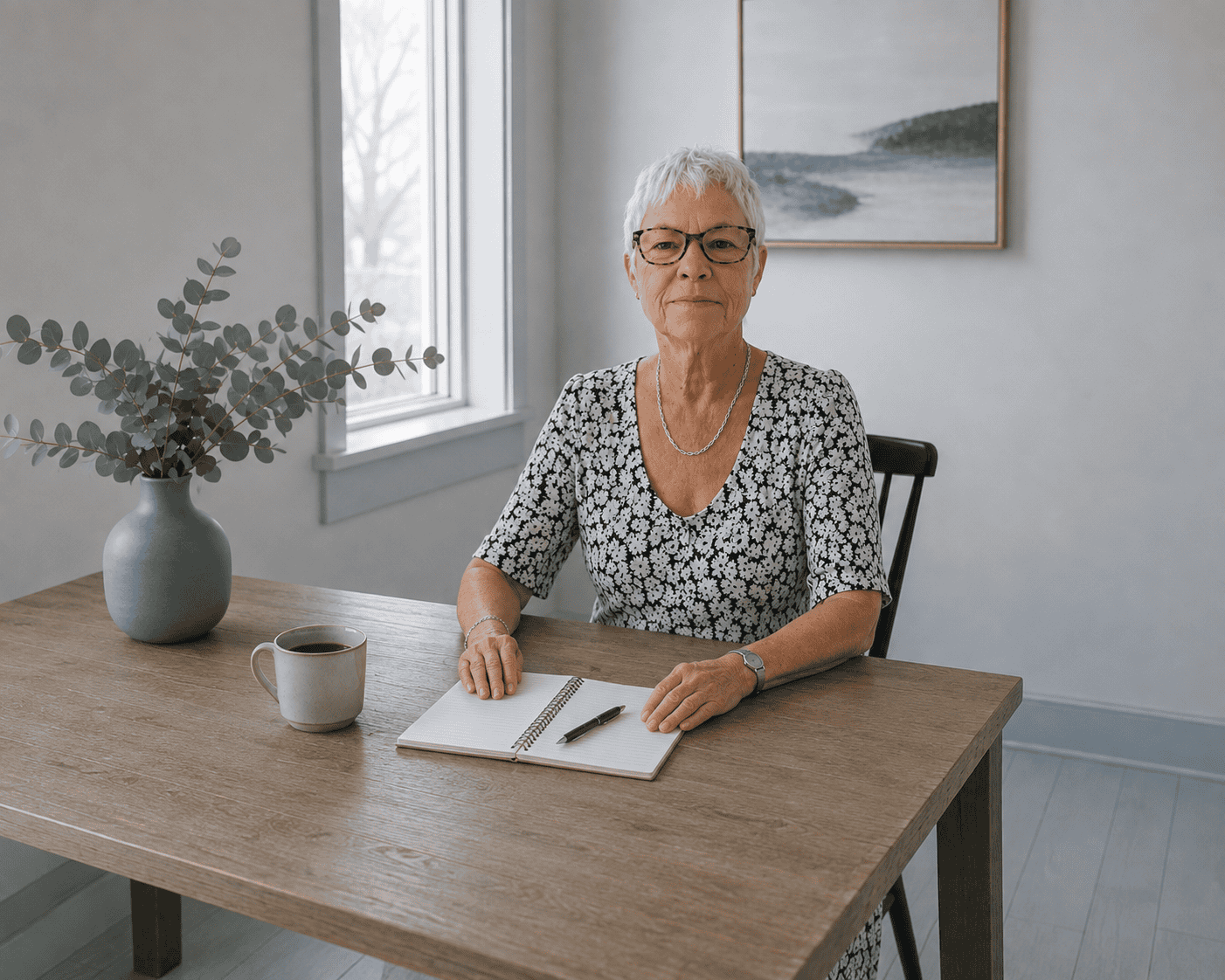
Retirement was meant to be a fresh start. Instead, it showed me I didn't have things as figured out as I thought. I had a plan, but life had other ideas.
For years, money had been tight, but I soon realised just how fragile things really were. Friendships changed, too. Some grew stronger, while other people simply drifted away as life moved on.
While everyone else seemed to be getting on fine with their lives and careers, I felt like I was constantly wading through one problem after another. There were days I felt completely overwhelmed—days where just getting out of bed and dressed was about as much as I could manage and thinking about the future felt exhausting.
I’d spent twenty years working in online business startup strategy, psychotherapy and coaching. But life kept stepping in—family crises and setbacks constantly threw me off course.
Even so, I had a vision for this stage of my life. My kids were grown up, my parents had passed away and I finally had the time. I wanted to take everything I’d learned over the decades and use it to help others. And I was actually starting to make progress.
I felt I’d earned a bit of breathing space. After everything, I was looking forward to some freedom, a bit of travel and some peace and quiet. Things were supposed to get easier.
It didn't turn out like that.
Looking back, I spent the first four years of my retirement just trying to catch my breath after the years before. At least, that's what I thought I was doing.
Then, a week after my 70th birthday, I was diagnosed with stage 4b ovarian cancer. The doctor used words like advanced and aggressive. You watch your family’s faces fall, while a strange part of your brain sits there wondering if you left a light on at home.
Right now, the cancer is in partial remission. It’s not gone, but it’s quiet. I’ve had to learn to live with "for now." It isn't easy, but it leaves you no choice but to stop worrying about the future and just live in the present.
The cancer wasn't the only thing, either. It was just the biggest one, sitting on top of everything else I was already carrying.
I’m not telling you this so you feel sorry for me. At our age, we’ve all been through the mill in one way or another. I’m sharing it because of the conversations I have with other retirees—the things people say when they’re being completely honest.
Stepping into retirement brings challenges no one warns you about, and they usually arrive all at once. Health troubles, money worries, changing relationships, losing your sense of who you are, feeling a bit lost... all while the outside world assumes you’re just putting your feet up.
This isn't about the cancer. It’s about what happens when life strips away your plans and you’re left having to figure out who you are now.
To understand where I am today, though, I need to tell you a bit about how I got here.
I have learned "for the moment" is actually a powerful place to stand.
What I Am Building
Everything I’ve been through—the cancer, the money shocks, changing relationships, feeling lost, the days of despair and the days of unexpected joy—has led me to one conclusion: none of you should have to go through this alone.
And yet, most people do. Because nobody likes to talk about the hard parts of retirement. Because admitting you’re struggling feels like failure when everyone else seems to be getting on just fine. And because the support out there is either clinical, patronising or aimed at someone twenty years younger.
So I’m building something different.
The podcast—The Bright Side of Loss—is where I share what’s happening in real time. Each episode looks at the realities that retirement brings and what happens when you face them instead of hiding away.
The Field Notes are where I write week to week—about the setbacks, the small victories, the tough days and the moments of unexpected grace.
The book I’m writing tells the fuller story. The one that takes longer to tell—with all the detail, the dark parts and the light.
And the community is for anyone who recognises themselves in what I’m describing. People whose retirement hasn't gone to plan. People facing things they never expected. People who know that adaptability and resilience aren't motivational slogans, but things you live every day. People who understand that having real support isn't abstract—it's the difference between sinking and swimming.
I’m not setting myself up as an expert on retirement. I spent years as a psychotherapist and coach and that experience naturally shapes how I see things. But this isn't therapy and I’m not here to coach you. This is something else entirely.
I’m simply someone with Stage 4b ovarian cancer, sharing what happens when retirement becomes a masterclass in everything you thought you already understood. I'm sharing what I learn as I go and building a space for others who are walking a similar road.
I don't have it all worked out. But I’ve learned that facing what comes is better than running from it. That living in the present isn't a luxury, but a necessity. And that the best way to get through the unexpected is to stop pretending you have to manage it all on your own.
Facing what comes is better than running from it. And none of us have to do it alone.
What I Believe
I believe that the challenges retirement throws at you aren't a sign that anything has gone wrong. They’re just what’s there. And the only way through is straight through—not around it, not over it and certainly not by pretending it isn't happening.
I believe that living in the moment isn't some airy-fairy idea. It’s what keeps you going. When the future is uncertain and the past is gone, right now is the only solid ground under your feet. Learning to stand on it—and occasionally find a bit of laughter on it—is the most important thing I’ve learned.
I believe that being adaptable isn't giving in. It’s the fiercest kind of strength going. When the original plan falls apart, having the grit to make a new one—and then another, and another—is what keeps you moving forward.
I believe that resilience isn't about never falling over. It’s about what you do when you’re on the floor. Sometimes what you do on the floor is have a proper cry. Sometimes you just lie there and rest. And sometimes, you notice that the view from down here is different—and that different isn't always worse.
I believe that none of us are meant to cope alone. And that the sheer kindness of others, when you’re brave enough to ask for help, can take your breath away.
I believe you’re far more capable than you give yourself credit for, especially on the days when you don't feel it at all. Those days lie to you.
And I believe—stubbornly, against all evidence on the bad days—that the best bits might still be ahead.
I believe that none of us are meant to cope alone. And that the sheer kindness of others, when you’re brave enough to ask for help, can take your breath away.
What Facing It Head-On Taught Me
When my husband of 14 years, Dave, died suddenly at just 47, we’d only been in California for five weeks. Five weeks after leaving the UK full of hope and plans for the future. We’d barely unpacked the boxes. The kids were nine and ten and calling out for their dad and I was standing in a country I barely knew, trying to work out what on earth I was supposed to do next.
I had a background in psychology. I could have given you a lecture on the stages of grief. But knowing the theory of grief and actually living inside it are two completely different things. The textbooks don't tell you about standing in a supermarket aisle completely blank, forgetting what you came in for because your brain has just stopped working. They don't mention the endless administration of death—the paperwork, the phone calls, the decisions you’re forced to make when you can barely remember what day of the week it is.
What I learned was that resilience doesn't look like those inspirational quotes on posters. It’s getting up and making the kids' packed lunches when you’ve been wide awake since three in the morning. It’s just showing up. That’s pretty much it. You just keep showing up.
Plans Are Overrated
I’ve never really been one for rigid planning. I had a rough idea of where I wanted to go but my life never went in a straight line. I left school at seventeen with next to no qualifications, which I always regretted. So I spent years studying, eventually getting a degree and then a Masters. Along the way, I worked my way through insurance, administration, staff training and team management. I was finally ready to embark on an exciting new career as an IT information systems specialist.
Then Dave died and my career plans evaporated into thin air.
So I rebuilt. I got into university research and lecturing. Then a nasty car crash in 2003 coupled with caring for my kids, knocked that on the head, so I retrained as a hypnopsychotherapist and later as a coach. Built things up all over again. Then came more family caregiving, helping with the grandchildren and looking after my terminally ill mum. Every time I got something steady going, life had other ideas.
I won't pretend otherwise. It was exhausting. Sometimes it was just relentless.
But somewhere along the way, I stopped grieving the loss of a career and started paying attention to what I was actually getting good at—which was problem solving and starting again. Not because I'm particularly brave or special, but because there simply wasn't a choice. I’m sure you know exactly what I mean. When you’ve got children depending on you, a parent who needs care or bills that won't pay themselves, you don't get the luxury of falling apart for very long. You get a weekend, maybe and then Monday morning comes round again.
What I will say is this: being adaptable isn't giving up. Giving up is when you stop caring. Adaptability is caring so much that you’re willing to scrap the map and find another way. I scrapped a lot of maps.
Who Shows Up and Who Doesn't
You find out very quickly who your friends are. When your world falls apart, some people you counted on just quietly drift away. They don't mean any harm—they just don't know what to say, so they say nothing at all. Then too much time passes, it gets awkward and that’s that.
Other people surprise you completely. My brother, sister and in-laws, who were grieving themselves, were always there with a shoulder to cry on, offering practical help. A workmate of Dave’s and his wife, who I barely knew, rang regularly to offer support and invited us round for weekends. A friend called almost every day and had us over for tea every week, knowing I needed the company (and that we needed feeding!). Other old friends said nothing particularly profound, but they just kept turning up, week after week, being steady. And my mum was an absolute rock, keeping us all afloat until her own health began to fail.
Asking for help, though—that was harder than anything. I’d spent my whole adult life being the capable one. Asking someone to pick up my kids because I couldn't hold myself together felt like admitting I was failing. It wasn't failing, of course. I know that now. But at the time, it took a lot to make those phone calls.
If you’ve been through anything like that, you’ll know that the people who stand by you when things are genuinely bad are worth more than words can say. And you probably also know that you became one of those people for someone else down the line because you know what it actually feels like to need a hand.
Working Out Who You Are Now
So I reached retirement thinking, Right, that’s enough drama, surely this is the quiet stretch. And in some ways, it is. But nobody warned me about the rest of it. The sudden loss of structure. The way your identity shifts and you become "a retiree" rather than someone who’s lived a rich, full life. The strange loneliness of days that have no shape unless you give them one.
I went looking for something that might help with all of that. Honest, practical, down-to-earth support for people like me—people who’ve lived full, complicated, sometimes very tough lives and are now trying to work out what this time is actually for.
I couldn't find much. Most of what was out there was either patronising or trying to sell me a vision of retirement that looked nothing like my real life. So I set about building what I was looking for myself.
And here’s the thing I wasn't expecting: figuring out who you are when the old roles have fallen away is uncomfortable and it can be bloody lonely. But every now and then, you get these moments of quiet clarity. You look back at everything—the studying, the loss, the starting over, the caregiving, all of it—and you think, Oh. Right. That’s what I actually know. That’s what I’ve got to offer.
Not a glossy reinvention story. Just a life, lived honestly, with a fair amount learned along the way. And the quiet feeling that it would be a waste not to do something useful with it.
Where to Start
If you’d like to hear more, the podcast is the best place to start. I publish a new episode every Thursday—honest, warm conversations about the realities retirement brings and what happens when you face them. Recorded right here at home, usually with a cup of tea going cold beside me.
If you’d like to keep in touch, the Field Notes are where I write about what’s actually happening week to week—the setbacks, the small breakthroughs, the tough days and the unexpected moments of joy that sneak in when you stop looking for them.
And if you’d like to be part of what I’m creating, the waitlist for founding members is open.
I’d love to have you with us.